 Comparison
Flooring Options for Care Home Corridors Compared
Last Updated: November 22, 2026
Quick Summary
The best flooring options for care home corridors are sheet vinyl and cushioned vinyl for safety-critical routes, commercial-grade luxury vinyl tile for design flexibility, and carpet tiles with acoustic underlays for quiet, dementia-friendly zones. Most well-planned care homes use more than one, matching each stretch of corridor to its real use.
- Sheet vinyl with welded seams leaves dirt nowhere to collect, making cleaning faster and infection control easier.
- R10 is the common starting point for slip resistance in care setting circulation areas.
- Ask suppliers for both the R rating and the pendulum test value for the wet condition.
- Carpet with deep pile or thick underlay makes wheelchair self-propulsion harder and tires the user.
- Replace one stretch of corridor per year on a rolling programme to spread cost and disruption.
Table of Contents
- What flooring options work best for care home corridors?
- A corridor-specific comparison of the main flooring types
- Care home safety flooring: slip resistance, falls and CQC expectations
- Commercial vinyl flooring for care homes: hygiene, durability and infection control
- Flooring for wheelchair users: roll resistance, comfort and transitions
- Care home flooring maintenance, whole-life cost and replacement planning
- Installing corridor flooring in an occupied care home
- Book a corridor flooring consultation for your care home
- Frequently Asked Questions
What flooring options work best for care home corridors?
The best flooring options for care home corridors are sheet vinyl and cushioned vinyl for safety-critical routes, commercial-grade luxury vinyl tile for design flexibility, and carpet tiles with acoustic underlays for quiet, dementia-friendly zones. Each suits a different stretch of the same corridor, and most well-planned care homes use more than one.
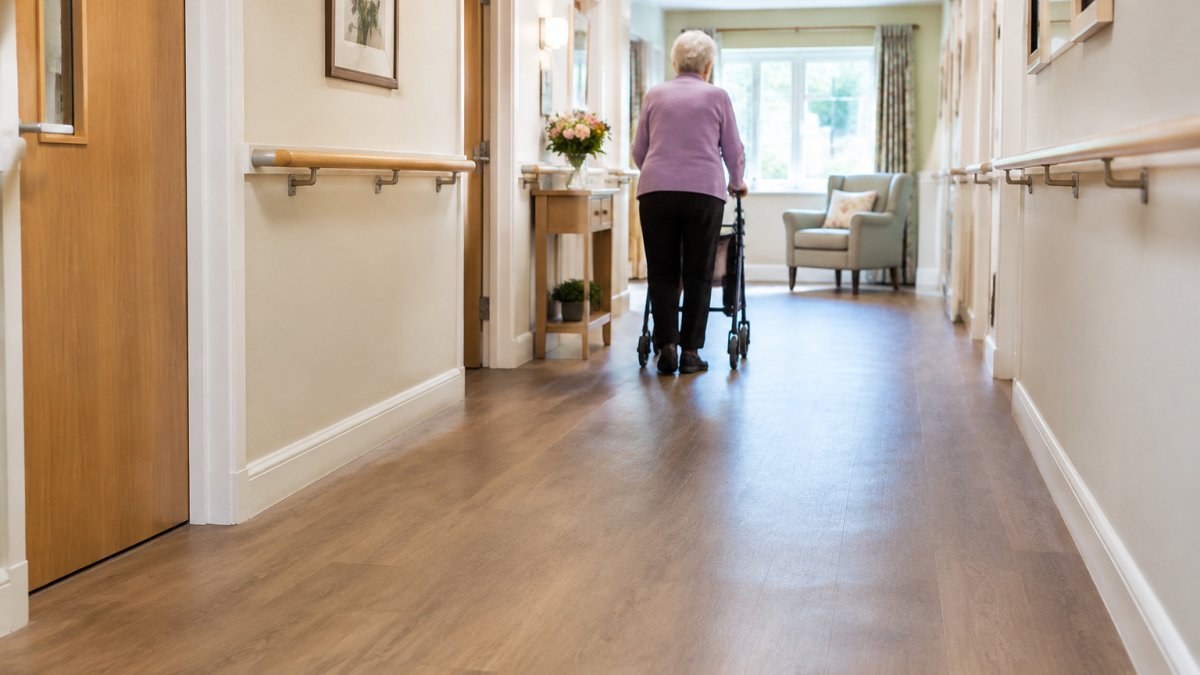
Corridors are the hardest-working surface in any care setting. Residents walk them at night, staff push trolleys along them, wheelchairs and walking frames turn on them, and cleaning teams work them every day. Corridors are where flooring is tested hardest in any care setting, and the same pattern comes up: the corridor fails first, not the bedrooms. That is why corridor flooring deserves its own specification rather than a hand-me-down decision from the lounge or the dining room.
Below, we compare the main flooring types against the criteria that actually matter in a corridor: slip resistance, hygiene, wheelchair roll resistance, acoustics, maintenance and whole-life cost.
A corridor-specific comparison of the main flooring types
Most guides compare flooring by material and leave it there. That misses the point. A corridor is a transit area, so it is judged on how it performs under constant movement, not how it looks in a showroom. Here is how the three main families compare on the things care providers actually ask us about.
| Flooring type | Slip resistance | Hygiene and cleaning | Underfoot comfort | Acoustics | Best for |
|---|---|---|---|---|---|
| Sheet vinyl / cushioned vinyl | High, with textured safety grades | Excellent, welded seams | Good with cushioning | Moderate | Wet zones, clinical routes, main corridors |
| Commercial-grade LVT | Good when specified correctly | Very good | Fair, firmer underfoot | Moderate | Feature areas, dining and activity zones |
| Carpet tiles with acoustic underlay | Lower, needs careful spec | Harder to deep clean | Excellent | Excellent | Quiet corridors, dementia-friendly zones |
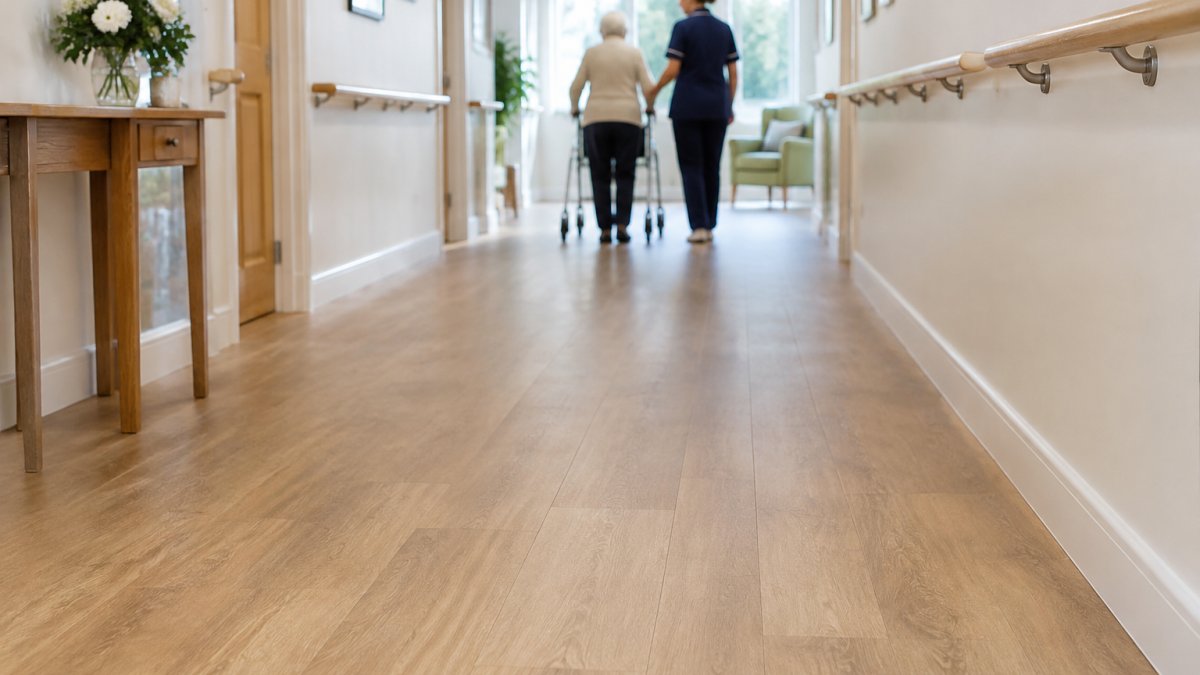
Sheet vinyl and cushioned vinyl
Sheet vinyl is the default choice for care home corridors, and for good reason. A single continuous sheet with welded seams leaves dirt and moisture nowhere to collect, which makes cleaning faster and infection control easier. Cushioned vinyl adds a foam backing that softens the floor underfoot, which matters for elderly residents who shuffle rather than stride.
The trade-off is that sheet vinyl shows damage from dragged equipment more readily than tile, and a tear in a corridor means a patch repair rather than a single tile swap. Specify a commercial safety grade rather than a domestic sheet, and insist on welded seams at every junction.
Commercial-grade LVT and linoleum
Luxury vinyl tile brings design flexibility that sheet vinyl cannot match. You can lay a border, change colour at a doorway, or create a visual contrast strip that helps residents with sight loss find their way. Individual tiles can be lifted and replaced if one is damaged, which keeps a corridor in service.
Linoleum is the quieter, more natural-looking option. It is made largely from renewable materials and holds up well in heavy traffic. Both need a flat, sound subfloor, and both are firmer underfoot than cushioned vinyl, so consider them for feature areas rather than every metre of a long corridor.
If you want to see how these tiles look and feel before committing, you can explore the luxury vinyl tile range and check options for corridor use.
Carpet tiles and acoustic underlays
Carpet in a care home corridor is not a compromise if it is specified properly. Carpet tiles with a dense, low-pile construction and a good acoustic underlay can reduce impact sound, which helps in homes where noise travels at night. Carpet also feels warmer and softer underfoot, and a fall on carpet is generally kinder than a fall on a hard surface.
The catch is cleaning. Carpet holds dust and spills in a way hard flooring does not, so it needs a proper vacuum and extraction regime. Use carpet in quieter residential corridors rather than wet or clinical routes, and always fit a transition strip where carpet meets vinyl. You can browse the carpets and underlay options to compare pile types for corridor use.
Care home safety flooring: slip resistance, falls and CQC expectations
Care home safety flooring is a floor covering specified to reduce slip risk in areas where residents walk, and it is assessed against slip-resistance ratings rather than sold as a generic "non-slip" product.
Slip resistance is usually expressed as an R rating under DIN 51130, the ramp test used across the flooring industry, and R10 is the common starting point for circulation areas in care settings.
The R rating is not the only test that matters.
Watch out: a common mistake is accepting a supplier's "non-slip" label without a stated rating or test method. Ask for the rating in writing and check it covers the wet condition.
Falls in care homes are not only a slip problem. For a deeper look at specifying safe flooring room by room, read our guide to safe flooring for nursing homes.
Commercial vinyl flooring for care homes: hygiene, durability and infection control
Commercial vinyl flooring for care homes is a heavy-duty sheet or tile product designed to withstand frequent cleaning and disinfecting without losing its surface. The key word is commercial: domestic vinyl wears through in a busy corridor far sooner.
Hygiene comes down to seams and edges. Welded seams, coved skirting and tight junctions to door frames leave no gap for soil to sit in. Durability comes down to wear layer thickness and the quality of the subfloor beneath it. A premium vinyl laid over a moving subfloor will fail early regardless of its specification.
Infection control teams generally prefer hard, seamless surfaces in clinical and wet routes, with carpet kept to quieter residential stretches. Whatever you choose, agree the cleaning regime with your housekeeping team before installation, because a floor that cannot be cleaned the way the home actually works will not stay hygienic. You can view the safety flooring range to see products suited to these routes.
Flooring for wheelchair users: roll resistance, comfort and transitions
Flooring for wheelchair users needs low roll resistance, which means a smooth, hard surface that lets wheels turn and travel without drag. Carpet with a deep pile or a thick underlay makes self-propulsion harder and tires the user, so keep carpet to low-pile, dense tiles if it is used at all on wheelchair routes.
Transitions matter as much as the main surface. A threshold strip that stands proud of the floor is a trip hazard for walkers and a jolt for wheelchair users. Every change of material should be flush, chamfered and securely fixed. The same applies at lift entrances and doorways, where the floor often changes.
Comfort is the counterweight. Hard flooring is easier to roll on but harder to stand on, so staff who are on their feet all shift notice the difference. Cushioned vinyl is the usual compromise: firm enough for wheels, softer than standard vinyl underfoot.
Care home flooring maintenance, whole-life cost and replacement planning
Care home flooring maintenance is the single biggest driver of whole-life cost, and it is the figure most buying decisions ignore. The purchase price is only the start. Cleaning time, products, periodic deep cleans and early replacement all add up over the years a corridor stays in service.
A useful way to compare options is to build a simple whole-life cost model for each corridor.
The cost drivers differ by product. Sheet vinyl with welded seams is cheap to clean daily but a tear means a patch repair rather than a tile swap.
Plan for replacement rather than react to it. A corridor that is patched repeatedly costs more in disruption and downtime than one replaced on a schedule.
The cheapest floor to buy is rarely the cheapest to own. A mid-range commercial vinyl with welded seams, cleaned daily and repaired promptly, usually outlasts a cheaper sheet that fails at the seams within a few years.
Installing corridor flooring in an occupied care home
Installing corridor flooring in an occupied care home is a logistics exercise as much as a fitting job. Residents still need to move safely, staff still need to work, and fire routes must stay clear at all times.
Plan the work in phases, one stretch of corridor at a time, with a clear diversion route and handrails maintained throughout. Agree start and finish times around meal service, medication rounds and night care. Keep adhesive and dust away from residents, and make sure the subfloor is checked and prepared before the fitting day.
A common mistake is booking the fit before the subfloor has been assessed. On occupied sites, a survey before any work is sensible, with the work scheduled around the home's routine.
Book a corridor flooring consultation for your care home
Choosing corridor flooring for a care home comes down to matching each stretch of corridor to its real use: safety vinyl where slip risk and hygiene lead, LVT where design and repairability matter, and carpet tiles where quiet and comfort count. Get that match right and the floor performs for years.
At Mobile Carpets and Flooring SW Ltd, we bring thousands of samples to your door so you can compare safety vinyl, LVT and carpet tiles in the actual light of your corridors. You can arrange a commercial flooring consultation to talk through your corridors.
Corridor flooring is one of the few decisions in a care home that touches resident safety, staff workload and your inspection record at once. If you are planning a refurbishment or replacing a worn corridor, we will bring the samples to you, talk through ratings and cleaning regimes, and fit the result properly.
Frequently Asked Questions
Is vinyl flooring suitable for care home corridors?
Yes. Sheet and cushioned vinyl are among the most common choices for care home corridors because seams can be heat-welded to create a washable surface, and slip-resistant grades are available with R10 ratings or above. Vinyl also copes with trolley traffic and frequent mopping. The key is specifying a commercial-grade product rather than a domestic one, and checking the manufacturer's slip rating for both dry and wet conditions before you commit.
What flooring is safest for older people in corridors?
Safety comes from three things: slip resistance, low trip risk and visual clarity. A slip-resistant sheet vinyl or safety vinyl with an R10 or higher rating handles spills and cleaning water better than smooth surfaces. Avoid deep pile carpet, loose mats and raised thresholds that catch walking frames. Patterned designs with clear tonal contrast at doorways and junctions also help residents judge where they are, which matters for fall prevention in care home corridors.
How often should care home corridor flooring be replaced?
There is no fixed interval. Replacement depends on traffic volume, product quality, cleaning regime and how well the floor has been maintained. A commercial-grade sheet vinyl in a busy corridor may last many years if seams and edges hold, while a cheaper product in a high-traffic route can wear through sooner. Inspect regularly for lifting seams, worn walkways and surface damage, and plan replacement around wear patterns rather than a set calendar.
What flooring features help residents with dementia?
Dementia-friendly design uses visual contrast to support wayfinding. Corridors should avoid busy, high-contrast patterns that can look like obstacles, and floor tones should differ clearly from walls and door frames so residents can read the space. Matt finishes reduce glare from ceiling lights. Consistent colour across a route helps residents follow it, while a change of tone at a doorway signals a threshold. Discuss these choices with your flooring supplier before specifying.