 How-to
Book Home Flooring Consultation Plymouth | Mobile Showroom
Table of Contents
- Why Book a Home Flooring Consultation Instead of Visiting a Showroom
- What to Expect During Your At-Home Flooring Appointment
- Our Flooring Installation Preparation Checklist
- How to Measure a Room for New Flooring Before the Fitter Arrives
- How to Prevent Damaged Baseboards During Flooring Installation
- Choosing the Right Flooring for Your Plymouth Home
- Book Your Free Home Measure and Quote Today
- Frequently Asked Questions
Last Updated: September 6, 2026
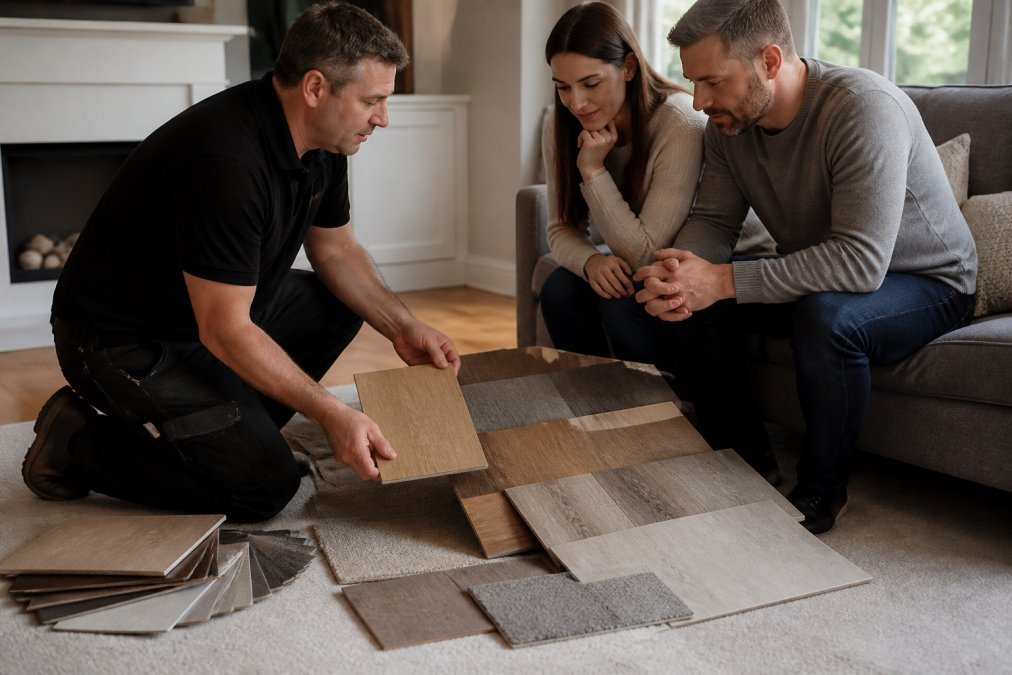
A home flooring consultation brings flooring samples directly to your home so you can choose materials in the space where they will be installed. Mobile Carpets and Flooring SW Ltd has over 25 years of experience. Below, we show you how the process works, what preparation is needed, and how to avoid common installation mistakes.
Why Book a Home Flooring Consultation Instead of Visiting a Showroom
The biggest advantage of an at-home appointment is context. A hallway that looks spacious in a showroom can feel different when you place samples against your own walls, skirting boards, and natural light. This is particularly valuable where older properties have unique layouts and period features a showroom cannot replicate.
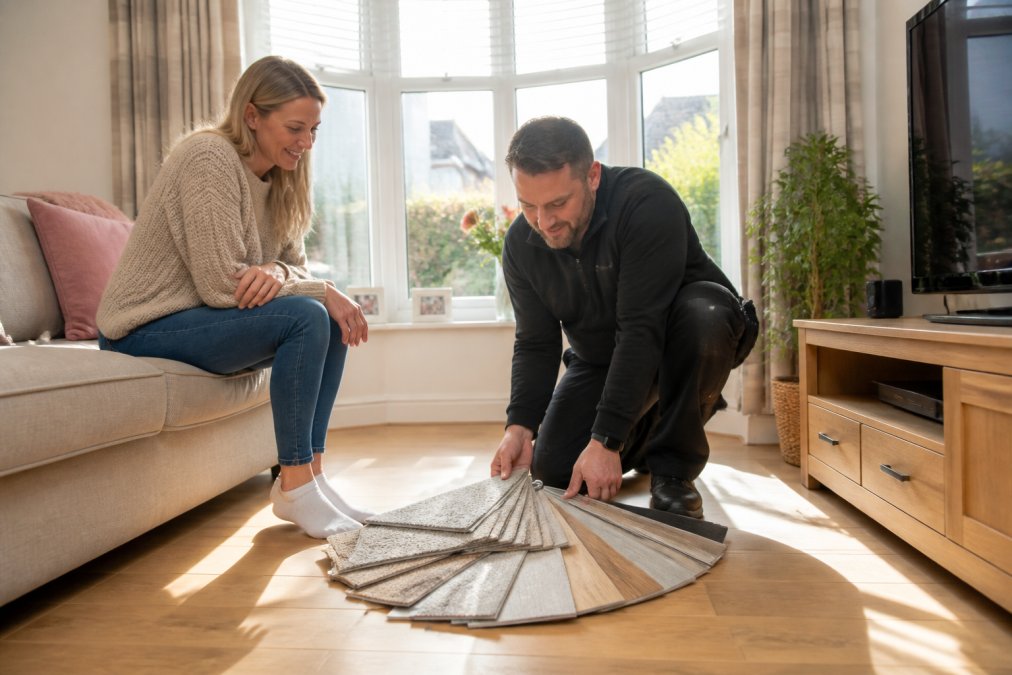
A mobile showroom saves hours of travel and avoids the pressure of deciding on the spot. You can take your time, live with samples in place, and discuss options with family before confirming.
Convenience is another major factor for busy professionals, the selection process happens on your schedule, often in a single evening or weekend visit.
What to Expect During Your At-Home Flooring Appointment
A typical consultation lasts 60 to 90 minutes. Your consultant arrives with a mobile showroom of thousands of samples, ready to discuss style, budget, and practical requirements. The session begins with a walkthrough of your property, allowing the consultant to assess the subfloor, check for damp issues, note uneven areas, and measure each room accurately, so the written quote you receive afterwards is precise and reliable.
Samples You Can See in Your Own Lighting
Carpet, luxury vinyl tile, and laminate look dramatically different under warm LED bulbs versus cool daylight. Holding samples against your floor and walls shows exactly how colour and texture behave throughout the day.
You can also test how samples feel underfoot, important for bedrooms where softness matters and hallways where durability is the priority. A good consultant guides you without rushing.
Our Flooring Installation Preparation Checklist
A professional installation starts 48 hours before the fitters arrive. This guide walks through what matters on fitting day.
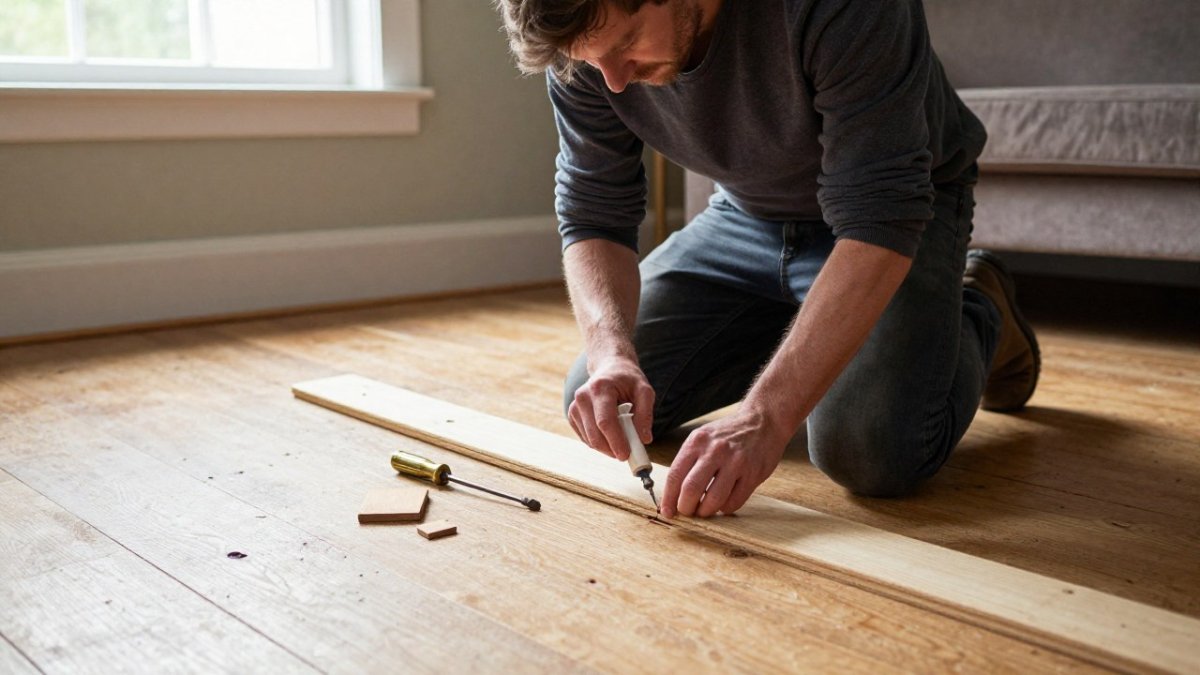
48 Hours Before: The Subfloor Inspection
The single biggest cause of fitting-day delays is a subfloor that hasn't been checked. Lift any loose rugs and look for the following:
- Loose or squeaky floorboards, screw them down with countersunk screws, not nails, which work loose over time.
- Damp patches or musty smells, especially near external walls or under bay windows. A damp subfloor will ruin any flooring within months. If you suspect moisture, tell your consultant before the fitting date so they can recommend a suitable moisture barrier or a different material.
- Uneven concrete, use a straightedge (a long spirit level works) across the floor. Gaps over 3 mm need self-levelling compound (mapei.com).
- Old adhesive or paint residue, this must be scraped back to bare concrete or timber, or the new underlay will not sit flat.
24 Hours Before: Furniture and Access
Moving furniture protects the items and ensures fitters can work efficiently.
- Empty wardrobes and chests of drawers completely. A fitted wardrobe that is half-full is dangerously heavy to shift.
- Move large items to a garage or a single room that is not being fitted. If you have nowhere to put them, ask your provider in advance, many supply-and-fit teams offer a furniture-moving service for an additional fee.
- Remove curtains and net curtains if you are having carpet fitted. The stretching process can pull at curtain poles, and dust from the underlay will settle on fabric.
- Take down wall art, mirrors, and shelving within 1.5 metres of the floor. Carpet stretchers need a clear run against the skirting, and vibration can knock items off their hooks.
- Check access to the room. Fitters need to bring in rolls of carpet or packs of planks. Measure doorways, stairwells, and any tight corners. A 4-metre carpet roll cannot bend around a sharp turn; if access is tight, mention it when booking (carpet-rug.org).
The Morning of Fitting: Final Checks
- Vacuum the subfloor thoroughly. For hard floors, wipe down with a barely damp cloth to remove fine dust that prevents adhesive from bonding.
- Confirm water and power are accessible. Underlay and fitting tools require electricity; some adhesives need water for clean-up. Fitters will not use your bathroom without permission, so leave a note if you are out.
- Secure pets. Even the calmest dog can be distressed by the noise of a carpet stretcher or an underlay trimmer. Arrange for pets to be in a separate room or out of the house entirely.
- Have a contingency for the weather. If you are having hard flooring fitted and the room has large windows, rain can blow in and wet the adhesive. Close windows or have old sheets ready to cover the work area.
What Happens If You Skip These Steps?
A skipped preparation step rarely cancels the job, but it often adds cost. A subfloor that needs levelling adds extra labour and materials. If furniture has not been moved, fitters may refuse to work around it, and you may be charged a wasted-call-out fee.
Preparation protects your deposit and ensures your new floor is installed on a surface that will last. Different floors have different requirements: carpet needs a clean, dry, smooth subfloor; LVT needs a perfectly level one; solid wood needs an acclimatised environment. Ask your consultant for a tailored checklist.
How to Measure a Room for New Flooring Before the Fitter Arrives
Measuring a room is straightforward with a tape measure, a notepad, and about ten minutes per room. For a rectangular room, measure the length and width at the widest points, then multiply them together to get the square metre area. Add 5 percent to account for cutting waste and pattern matching. For L-shaped rooms, split the space into two rectangles, calculate each area separately, and add them together. For carpet, remember it comes in rolls with fixed widths, your measurements help the supplier cut it economically. For hard floors like LVT or laminate, you need the total square metre figure, as planks and tiles are priced per square metre. A common mistake is measuring at floor level where skirting boards protrude. Always measure wall to wall at the floor, not at the skirting edge, to avoid ordering too little material.
How to Prevent Damaged Baseboards During Flooring Installation
Damaged baseboards are the most frequent complaint after installation. The damage usually comes from fitters using skirting as a lever point when stretching carpet, or from heavy tools knocked against the wood during hard floor installation.
The first line of defence is communication. Before work begins, walk through the rooms with your fitter and point out older or painted skirting that may be brittle.
Protective tape applied to the base of the skirting boards before installation begins is the simplest and most effective measure. For carpet installation, ensure the fitter uses a knee kicker rather than bracing against the skirting.
After installation, inspect every room before the fitters leave. Check the baseboards for marks, chips, or gaps between the floor and the skirting. A quality installation leaves skirting boards looking exactly as they did before, with neat transition strips covering expansion gaps.
Choosing the Right Flooring for Your Plymouth Home
Selecting the right material balances aesthetics, durability, and maintenance against your household's needs. Here is a practical comparison of the four most common materials we fit across Plymouth homes.
Material Comparison at a Glance
| Material | Typical Price Range (supplied & fitted, per m²) | Water Resistance | Durability | Best For | Watch Out For |
|---|---|---|---|---|---|
| Carpet | £15-£35 | Poor, avoid in kitchens and bathrooms | 5-10 years in high-traffic areas | Bedrooms, living rooms, stairs | Stains and wear in hallways; requires professional cleaning |
| Laminate | £18-£40 | Moderate, some ranges are water-resistant, not waterproof | 10-15 years | Living rooms, dining rooms, hallways on a budget | Can warp if water sits on it; noisier underfoot |
| Luxury Vinyl Tile (LVT) | £25-£55 | Excellent, fully waterproof | 15-20 years | Kitchens, bathrooms, hallways, family homes with pets | Needs a perfectly level subfloor; can be cold without underlay |
| Engineered Wood | £45-£80 | Moderate, not for wet areas | 20+ years (can be sanded and refinished) | Living rooms, dining rooms, period properties | Expensive; requires acclimatisation before fitting |
Pricing depends on quantity, dates, and delivery. Your written quote will confirm the exact figure.
How to Decide Based on Your Home and Lifestyle
For a busy family home with children and pets: LVT is the strongest all-rounder, waterproof, scratch-resistant, and easy to clean. Modern ranges replicate oak or stone convincingly. If you prefer carpet in living areas, choose a stain-resistant synthetic fibre with a dense pile.
For a period property with original floorboards: Engineered wood is the premium choice, it is dimensionally stable and will not expand and contract as much with seasonal humidity changes, a critical factor in older homes. If floorboards are in good condition, sanding and sealing them can be an option.
For a rental property or first home on a budget: Laminate offers the best value. Choose an AC4-rated laminate for rental use, it withstands heavier foot traffic and furniture movement.
For a wetroom or accessible bathroom: Specialist vinyl with a textured surface is the only sensible choice. Look for a slip resistance value of R10 or higher (or a wet pendulum test value above 36) (hse.gov.uk). Seamless welded vinyl prevents water penetrating the subfloor, essential for elderly users or those with mobility issues.
The Hidden Costs That Change Your Decision
Consider the full cost of ownership, not just the price per square metre:
- Underlay: Carpet and laminate both need underlay. A good quality underlay extends the life of your floor and improves comfort and insulation. Skimping here is a false economy.
- Subfloor preparation: LVT requires a perfectly level subfloor. If your home has uneven floorboards or a concrete slab with minor undulations, self-levelling compound may be needed. Carpet is far more forgiving of minor unevenness.
- Acclimatisation: Wood and laminate products need to sit in the room for 48 hours before fitting to adjust to the humidity. This adds time to your project but prevents warping later.
- Removal of old flooring: Taking up old carpet and underlay may incur a cost. If you are removing glued-down vinyl or ceramic tiles, the cost may be higher due to the extra labour.
The Environmental Angle Most Sites Ignore
Environmental impact matters to many homeowners. Here is what to ask your consultant:
- Carpet: Wool-rich blends (80% wool / 20% synthetic) are naturally stain-resistant, biodegradable, and have a much lower carbon footprint than 100% synthetic fibres. Look for carpets with the EU Ecolabel or the Carpet and Rug Institute's Green Label Plus certification.
- LVT: Most LVT is PVC-based, which raises concerns about plasticisers and end-of-life disposal. Some manufacturers now offer 'bio-based' or partially recycled ranges. Ask whether the product can be recycled at the end of its life.
- Laminate: Made from compressed wood fibres, laminate is generally more eco-friendly than LVT, but the resin binders are not fully biodegradable. Check for FSC or PEFC certification on the wood content.
- Engineered wood: Look for FSC-certified sources and low-VOC finishes. A well-maintained engineered wood floor can last 20-30 years, making it a more sustainable choice over its full lifecycle than a cheaper floor replaced twice in the same period.
Bringing It All Together for Your Consultation
When you book your consultation, bring a list of rooms, your approximate budget per room, and lifestyle factors (pets, children, mobility issues, allergies). Your consultant will bring matching samples to see in your own lighting and test underfoot.
Book Your Free Home Measure and Quote Today
A free home measure and written quote remove the uncertainty from budgeting, giving you a clear figure before any work begins.
Mobile Carpets and Flooring SW Ltd brings the showroom to your door with thousands of samples and expert guidance. Our family-run business has served Plymouth for over 25 years, and our skilled fitters deliver professional installation with a seamless supply and fit service.
Book your home flooring consultation in Plymouth today and experience the convenience of choosing your perfect floor from your own sofa. Contact our flooring specialists to arrange a visit at a time that suits you.
Choosing new flooring should be exciting, not stressful. Mobile Carpets and Flooring SW Ltd solves this with a mobile showroom that comes to you, expert consultants, and professional installation teams who protect your property throughout. Get started and turn your renovation vision into reality with confidence.
Frequently Asked Questions
How long does an at-home flooring consultation usually take?
A standard consultation takes around 45 to 60 minutes. This allows time to discuss your needs, view samples in your own lighting, and answer questions about durability and care. If you need help measuring rooms or planning a layout, allow a little longer. The aim is to give you a clear picture without rushing the decision, so you feel confident before requesting a written quote.
Do flooring consultants provide free measurements during the visit?
Yes, accurate room measurements are part of the service. During the consultation, the specialist can measure your spaces to confirm quantities and identify any subfloor issues that might affect installation. This feeds directly into a written quotation, so the price you see reflects your actual rooms rather than an estimate. You will not need to arrange a separate survey visit.
Can I see flooring samples in my own lighting?
That is the main advantage of a mobile showroom. Carpet and luxury vinyl tile look different under shop lighting compared with your home's bulbs and natural light. Seeing samples against your existing skirting boards, paint colours and furniture helps you avoid choosing something that clashes once installed. You can also test how samples feel underfoot and check how they reflect light in each room.
What is the flooring installation preparation checklist for my home?
Clear the room of furniture and remove fragile items from walls before the fitters arrive. Vacuum and sweep the subfloor to remove debris. Ensure the fitter has access to a power supply and water if needed. Move vehicles to leave space for the van and materials. If you have pets, keep them in a separate room during installation. Confirm the installation timescale with your consultant so you know what to expect on the day.