 How-to
Safety Flooring for Care Homes: A Practical Buyer's Guide
Quick Summary
Safety flooring for care homes and clinics is a surface designed to reduce injury from falls, improve grip underfoot, or both, while resisting heavy traffic and cleaning well. The right choice depends on each room's use, water exposure and traffic level, rather than one floor for the whole building.
- Specify each room separately, based on its main use, water exposure and traffic level.
- Ask suppliers for the test data behind any slip rating, not just the word anti-slip.
- Shock-absorbing flooring may reduce fall-related injuries, but the evidence is very low quality.
- Wet rooms need continuous waterproofing carried up the walls and the correct floor fall to the drain.
- Judge cost over the floor's whole life, including hygiene, durability and maintenance.
Table of Contents
- Why Flooring Choice Matters in Care Homes and Clinics
- Room-by-Room Flooring Specification
- How to Assess Slip Resistance and the Standards That Apply
- Safety Vinyl Flooring: Strengths, Limits and When to Choose It
- Wet Room Flooring for Care Homes: Getting the Details Right
- Slip-Resistant Flooring for Care Homes: Hygiene, Durability and Maintenance Costs
- Planning Your Care Home Flooring Installation Without Disrupting Residents
- Frequently Asked Questions
Why Flooring Choice Matters in Care Homes and Clinics
Last Updated: November 6, 2026
Floors in care homes and clinics do more than look good. They are one of the few environmental factors that affect falls, infection control and daily wear, all at once. Poor floor choices can cause problems long after installation, so it pays to get the decision right from the start.
A systematic review published by researchers at the University of Portsmouth found very low-quality evidence that shock-absorbing flooring may reduce fall-related injuries in hospitals and care homes without increasing falls Shock-absorbing flooring for fall-related injury prevention in older adults. The result is uncertain, and that matters. Flooring is a sensible part of a falls strategy, but it is not a complete one on its own.
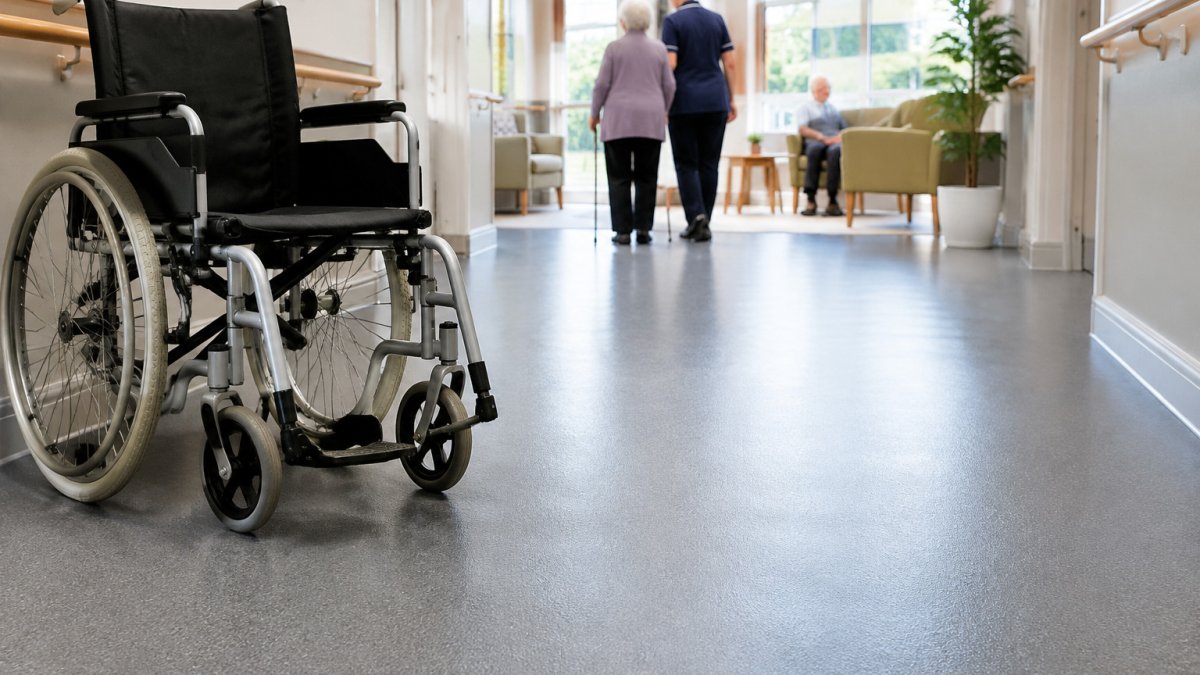
Safety flooring is a surface designed to reduce injury when someone falls, improve grip underfoot, or both. In a care setting, it usually needs to do several jobs together: resist slips, withstand heavy trolley and wheelchair traffic, clean down quickly, and stay comfortable to stand on for long shifts.
Compliant flooring is another term you will hear. A Cochrane review concluded that compliant flooring may reduce fall-related injuries but may also increase the risk of falls Compliant flooring to prevent fall-related injuries in older adults. That trade-off is a good reason to match the floor to each room rather than choosing one product for the whole building.
The rest of this guide walks through the decisions that matter most: specifying each room, checking slip resistance, comparing safety vinyl with other options, getting wet rooms right, weighing hygiene and maintenance costs, and planning an installation that does not disrupt residents.
Room-by-Room Flooring Specification
A common mistake is specifying one floor for an entire home. A corridor, a bedroom, a wet room and a kitchen face different loads, different spills and different fall risks. A room-by-room approach costs more time at the planning stage but can avoid replacing the wrong floor early.
Start with a simple grid: list each room, its main use, its water exposure and its traffic level. Then match a floor to each row. Corridors and communal areas usually need the most durable, low-maintenance surface. Bedrooms can prioritise comfort and a domestic look. Wet rooms and treatment areas need a floor that copes with standing water and frequent cleaning.
Keep the palette calm. Subtle patterns and muted tones reduce visual noise, which helps residents with dementia orient themselves. Avoid high-contrast patterns that can look like steps or holes.
The article suggests matching a floor to each room by its use, water exposure and traffic level, which can be summarised as follows.
| Room type | Main priority | Floor direction |
|---|---|---|
| Corridors and communal areas | Durability and low maintenance | Most durable, low-maintenance surface |
| Bedrooms | Comfort and domestic look | Comfort-led, domestic appearance |
| Wet rooms and treatment areas | Standing water and frequent cleaning | Floor that copes with water and cleaning |
How to Assess Slip Resistance and the Standards That Apply
Slip resistance is measured, not guessed, and the measurement only means something if you know which test produced it. Ask any supplier for the test data behind a floor's slip rating rather than relying on the word "anti-slip" on a sample board.
Slip-resistance results are often quoted using pendulum testing to BS 7976, which returns a Pendulum Test Value (PTV). That number is only meaningful for the surface condition and contamination state in which it was tested. Some ranges also quote a barefoot rating from the DIN 51097 ramp test and a shod rating from DIN 51130 (R values), which are not interchangeable with a PTV. Never compare a PTV against an R value and assume one floor is "safer" than another.
Wet and dry results can differ sharply, so check both. Sample the floor in the conditions it will face: a glossy surface that feels safe when dry can become hazardous after a spill. Ask for samples, wet them, and walk on them in your own shoes before committing.
Ask whether a supplier's headline rating comes from a factory-fresh sample or from a worn surface after cleaning and traffic.
For care providers, the Care Quality Commission (CQC) expects premises to be safe and suitable for the people using them (Regulation 15: Premises and equipment). Your local authority and fire safety requirements may also apply to floor finishes, particularly where escape routes are involved. The practical answer is to treat published ratings as one input to a site-specific risk assessment covering the actual contaminants (water, soap, food, bodily fluids), the actual traffic and the actual cleaning regime. Confirm the current requirements directly with the relevant regulator before you specify.
Safety Vinyl Flooring: Strengths, Limits and When to Choose It
Safety vinyl is the most common choice for care homes and clinics, and for good reason. It offers a cushioned or textured surface, many designs, seamless welded joints, and straightforward cleaning. Many commercial vinyl ranges also carry slip-resistance ratings suited to wet areas.
The limits are worth knowing. Cheaper vinyl can dent under heavy furniture, and poor installation shows quickly at seams and edges. Some textured surfaces trap dirt if they are not cleaned properly, which is a real concern in clinical areas.
Choose safety vinyl for corridors, bedrooms, dining areas and most communal spaces. For high-moisture rooms, check the product specification carefully before committing.
Wet Room Flooring for Care Homes: Getting the Details Right
Wet rooms are where flooring decisions carry the highest risk. Water pools, drains can be slow, and a slip on a wet floor is one of the most common injuries in residential settings.
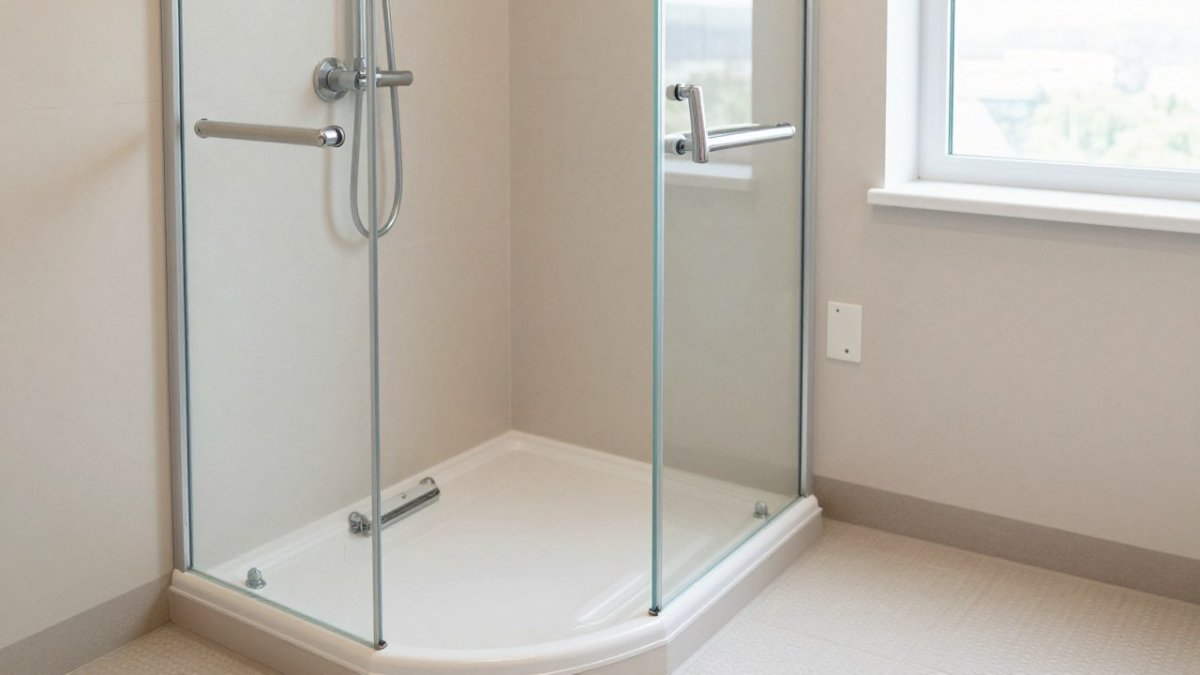
Specify a textured, slip-resistant surface with a fall towards the drain that is correct before installation. Ask the installer how they will achieve the fall and how the junction with the adjoining floor will be sealed. Watch out: a fall that is too shallow leaves standing water, and one that is too steep makes the floor feel unstable underfoot, both are difficult and expensive to correct after tiling or vinyl is laid.
Level-access showers should sit flush with the surrounding floor so there is no lip to trip over. That means the substrate, the drain position and the door threshold all need to be set out together before any finish goes down. Grab rails and contrasting edges help residents with reduced vision.
Waterproofing is the part most often skimped. A wet room needs a continuous tanking membrane or liquid-applied waterproofing system beneath the finish, carried up the walls to at least the shower height and dressed into the drain flange. Vinyl can be welded and coved up the wall rather than butted to a skirting, so spills are less likely to track behind it. Confirm the adhesive and sealant are suitable for continuously wet conditions and check the manufacturer's cure times before the room is returned to use.
Plan the work around occupancy. Wet rooms can be difficult to take out of service, so phasing refurbishment so that at least one accessible bathroom remains available on each floor is worth considering, and agreeing with the manager in advance how residents will be moved is sensible.
Slip-Resistant Flooring for Care Homes: Hygiene, Durability and Maintenance Costs
Cost should be judged over the life of the floor, not the price per square metre. A cheaper floor that needs replacing after three years, or that requires specialist cleaning products, can cost more overall than a durable option.
When comparing options, consider:
- Hygiene: seamless or welded joints, non-porous surfaces, and compatibility with your disinfectant regime
- Durability: wear resistance in high-traffic corridors and near entrances
- Maintenance: how often the floor needs stripping, sealing or deep cleaning
- Comfort: cushioning for staff standing for long periods and residents who walk unsteadily
Ask suppliers for the cleaning and maintenance instructions in writing. Floors that need unusual products or frequent stripping often turn out expensive in practice.
Pricing for this kind of project depends on the area, the product, the specification and the installation method. Contact Mobile Carpets and Flooring SW Ltd for a quote based on your actual rooms.
Planning Your Care Home Flooring Installation Without Disrupting Residents
Disruption is the hidden cost of flooring work in an occupied building. Residents need safe routes through the building, and noise, dust and furniture moves can cause real distress, especially for people with dementia.
Plan the work in phases, room by room, so that part of the home stays in use at all times. Agree a clear timetable with the manager, and make sure residents who need quieter rooms are moved in advance. Ask the installer how they will manage dust and protect corridors.
Adhesive and sealant cure times matter. Confirm when rooms can be safely reoccupied and when furniture can return. Clear, written communication with staff and families reduces stress for everyone.
When you are ready to plan your installation, book a safety flooring consultation with our team so we can talk through your rooms and timetable. You can also review our safety flooring range and our commercial flooring options to see what suits each area of your building.
Frequently Asked Questions
What type of flooring is best for care homes?
There is no single best option, but care homes usually need flooring that is slip-resistant, easy to clean, durable under heavy traffic and comfortable underfoot. Safety vinyl is the most common choice for corridors, lounges and bathrooms because it combines these qualities with a seamless finish that is easier to keep hygienic than loose-lay alternatives. Carpet can suit bedrooms and quieter areas where spills and infection control risks are lower. Ask your supplier for slip-resistance test data and cleaning guidance before you decide, and check the specification against your own risk assessment.
Is vinyl flooring suitable for care homes and clinics?
Vinyl flooring is widely used in care homes and clinics because it can be supplied in slip-resistant grades, cleaned with standard disinfectants and laid as a seamless sheet that avoids joints where bacteria collect. Safety vinyl with an embossed or textured surface gives better grip when wet. The main limitations are that cheaper vinyl can wear through in very high-traffic areas, and poor installation can leave edges that lift. Specify the wear layer thickness and fitting method rather than relying on appearance alone.
Does safety flooring need to be coved?
Coved edges, where the flooring curves up the wall, are generally preferred in clinical and care settings because they remove the sharp angle where dirt and moisture build up. This makes cleaning more thorough and reduces hygiene risks. Coving is particularly useful in wet rooms, bathrooms and treatment areas. Discuss the requirement with your installer early, as coving affects how the floor is prepared, sealed and finished.