 How-to
How to Choose Bathroom Flooring: A 2026 Guide
Table of Contents
- Assess Your Bathroom's Moisture and Traffic Levels
- Compare Bathroom Flooring Materials: LVT vs Ceramic Tiles
- Prioritise Slip-Resistant Bathroom Flooring Options
- Check Underfloor Heating and Installation Methods
- Factor in Maintenance, Durability, and Long-Term Care
- Understand if Safety Flooring is Covered by Home Insurance
- Get Expert Advice and Professional Installation
- Conclusion: Your Bathroom Flooring Decision
- Frequently Asked Questions
Last Updated: September 7, 2026
Choosing the right bathroom flooring is a balancing act between style, safety, and practicality. The bathroom faces constant moisture, temperature swings, and the daily risk of slips on wet surfaces. This guide from Mobile Carpets and Flooring SW Ltd, a family-run business with over 25 years of experience, breaks down the technical considerations that actually matter.
The goal is to help you avoid two common mistakes: choosing a material that becomes a safety hazard when wet, or selecting a cheap option that needs replacing within a few years.
Assess Your Bathroom's Moisture and Traffic Levels
Before comparing materials, understand the environment they will live in, and the subfloor they will be installed over. Bathroom flooring faces standing water, high humidity, and harsh cleaning chemicals, so water resistance is non-negotiable.
Evaluate three factors: direct water exposure, foot traffic, and ventilation. A bathroom with a separate shower has different needs than a wetroom where water spreads across the entire floor. High-traffic family bathrooms require flooring that resists scratching and staining.
The Subfloor: The Hidden Variable Most Guides Ignore
Subfloor preparation determines whether your new floor lasts five years or twenty-five. A waterproof surface on a damp or uneven subfloor will fail eventually.
Timber subfloors are common in upstairs bathrooms and period properties. They require a minimum of 18mm of tongue-and-groove boarding or 18mm plywood, screwed down at 300mm centres. The timber must read below 12% moisture content using a moisture meter before installation; higher readings indicate a damp problem that must be fixed first (gov.uk). A decoupling membrane (such as Ditra) is recommended beneath tiles to accommodate wood movement.
Concrete subfloors are standard on ground floors and in modern builds. New concrete must cure for at least six weeks. A hygrometer or calcium chloride test reading above 75% relative humidity means moisture is rising through the slab and will compromise any floor covering; a liquid damp-proof membrane applied directly to the concrete is the most reliable solution.
Levelness is the second critical requirement. British Standard BS 8203 and BS 5385 specify subfloors must be level to within 3mm over a 3-metre straightedge for flexible coverings, and within 5mm over 3 metres for rigid tiles (bsigroup.com). A self-levelling compound is the standard solution.
Moisture and Traffic Assessment: A Practical Method
A systematic assessment prevents costly mistakes:
- Identify the wet zones: Mark where water actually reaches, not just the shower or bath, but where someone steps out dripping and where condensation runs down walls. In a wetroom, the entire floor is a wet zone.
- Measure your traffic patterns: Count how many people use the bathroom daily. A household of four with one bathroom creates concentrated traffic peaks a single-person ensuite never experiences.
- Test your ventilation: Run the extractor fan for 15 minutes after a hot shower and check for lingering condensation. If moisture persists, no flooring material will compensate.
- Check for existing damp: Look for efflorescence, musty odours, or mould along skirting boards. These indicate a moisture problem that must be resolved before installation.
The Acoustic Dimension: A Missed Consideration
Acoustic insulation matters enormously in flats and multi-storey homes. The sound of water hitting tile, footsteps on LVT, or dropped toiletries can be clearly audible below.
Porcelain and ceramic tile are the noisiest options. A 20mm acoustic underlay beneath tiles, typically recycled rubber or cork, can reduce impact sound transmission. LVT performs better due to its flexibility, but a dedicated underlay still improves performance. For upstairs bathrooms in flats, check whether your lease requires minimum acoustic performance (often a maximum impact sound transmission of 62dB under Approved Document E) (gov.uk).
Compare Bathroom Flooring Materials: LVT vs Ceramic Tiles
The two leading contenders are luxury vinyl tile (LVT) and ceramic or porcelain tile. LVT vs ceramic tiles for bathrooms comes down to a trade-off between comfort and authenticity. Ceramic and porcelain offer a hard, authentic surface with excellent water resistance, but feel cold underfoot.
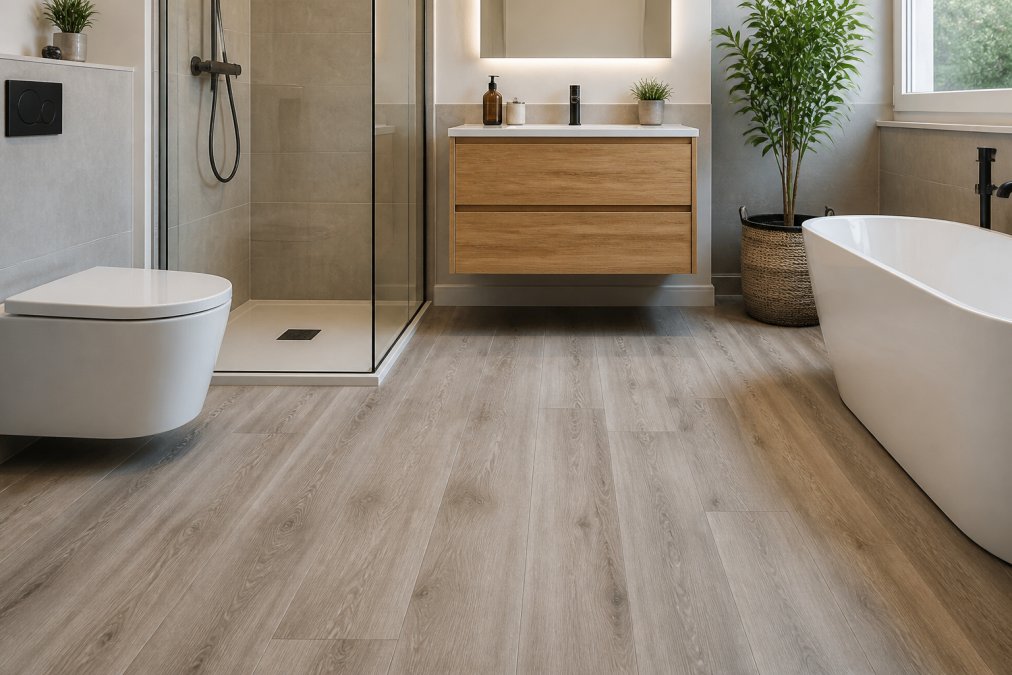
LVT mimics the look of stone or timber while providing a warmer, softer surface. High-quality LVT features a thick wear layer that protects against scratches and scuffs. Vinyl is also inherently water-resistant and quieter underfoot than tile. The main drawback is that cheaper versions can fade or dent, so wear layer thickness is critical.
| Material | Water Resistance | Comfort Underfoot | Durability | Best For |
|---|---|---|---|---|
| Luxury Vinyl Tile (LVT) | Excellent | Warm and soft | Good, depends on wear layer | Family bathrooms, wetrooms, upstairs rooms |
| Porcelain Tile | Excellent, very low porosity | Cold and hard | Excellent, long lifespan | Ground-floor bathrooms, high-traffic homes |
| Ceramic Tile | Good, requires sealing | Cold and hard | Good | Budget-conscious renovations |
| Laminate | Poor | Warm | Poor in moisture | Not recommended for bathrooms |
Prioritise Slip-Resistant Bathroom Flooring Options
Slip resistance is arguably the most important safety feature of bathroom flooring, yet it is frequently overlooked. Slip-resistant bathroom flooring options reduce the risk of falls on wet surfaces, especially for households with elderly members, young children, or anyone with mobility concerns.
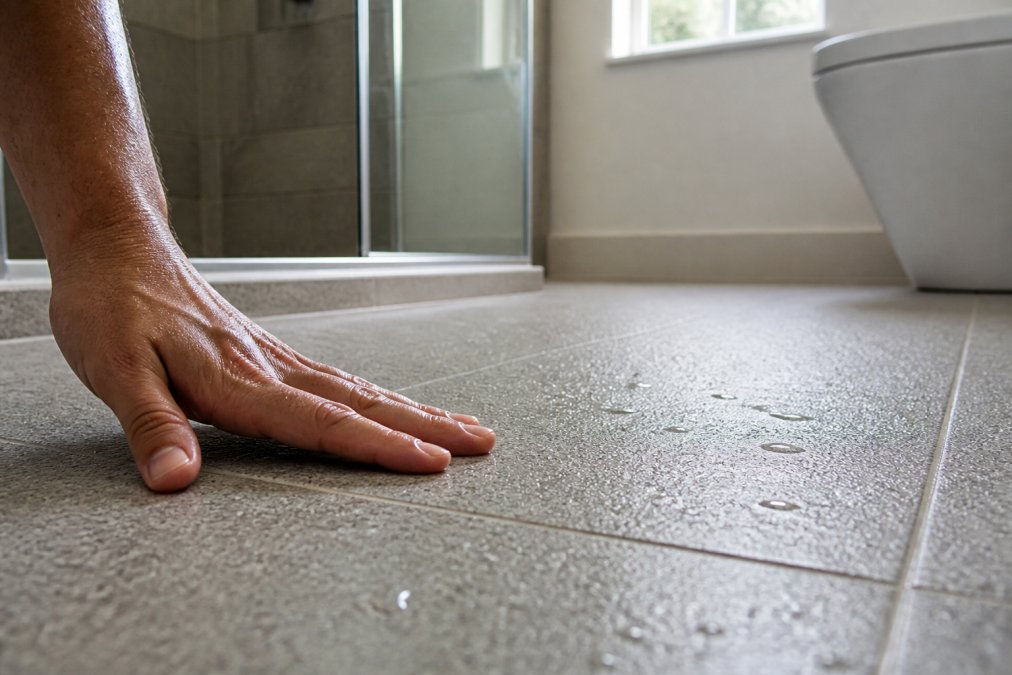
Higher texture generally means better grip, but also more effort to keep clean. Porcelain tiles are available with a textured or matt finish that provides better traction than polished varieties. LVT can be manufactured with embossed textures that replicate natural stone or timber grain while offering reliable grip.
Check Underfloor Heating and Installation Methods
Not every flooring material conducts heat equally well. Porcelain tile has excellent thermal conductivity, making it the ideal partner for underfloor heating. LVT also works well, provided the system operates at a lower temperature to avoid damage.
Installation methods vary between materials. Ceramic and porcelain tiles require a cement-based adhesive and grout lines, which need sealing to prevent moisture penetration. LVT can be installed as a floating floor or fully adhered; for bathrooms, full adhesion is recommended to prevent water seeping beneath the planks.
While some homeowners successfully install LVT as a weekend project, tiling a bathroom properly requires skill in subfloor preparation, cutting, and grouting. A poorly installed floor, regardless of material quality, will fail prematurely.
Factor in Maintenance, Durability, and Long-Term Care
The true cost of bathroom flooring extends beyond the purchase price, it includes the weekly cleaning routine, annual maintenance, and eventual replacement.
The Maintenance Burden by Material
Porcelain and ceramic tile are the most forgiving for daily cleaning, a microfibre mop with warm water and a pH-neutral detergent handles soap scum effectively. The real burden lies in the grout lines. Standard cementitious grout is porous and will discolour or grow mould within 6 to 12 months if not sealed; a penetrating sealer applied annually is the minimum. Epoxy grout is non-porous and never needs sealing.
Luxury vinyl tile (LVT) requires the least maintenance. A weekly sweep or vacuum with a soft brush, followed by a damp mop with a manufacturer-approved cleaner, is sufficient. The wear layer, measured in mils, determines scratch and stain resistance. A 20-mil wear layer is the minimum for bathroom use; 28-mil or higher is recommended for family bathrooms. Avoid rubber-backed bath mats, as the rubber can migrate into the vinyl, causing permanent yellow-brown staining.
Natural stone (limestone, travertine, slate) demands the highest maintenance. These materials are porous and require sealing every 6 to 12 months. Acidic cleaners, including vinegar and lemon juice, will etch the surface permanently, so a pH-neutral cleaner is required.
Failure Modes and What They Mean for Your Wallet
The most common failure modes in bathrooms are:
- Grout deterioration: Cracking or crumbling grout allows water to penetrate to the subfloor. If caught early, re-grouting can be addressed. If ignored, the subfloor can rot, requiring a full floor replacement.
- LVT wear layer breach: Once the wear layer is scratched through, moisture reaches the printed design layer, causing the pattern to fade or peel. This is not repairable, the affected planks must be replaced.
- Tile delamination: This occurs when the adhesive bond fails, often due to inadequate subfloor preparation or thermal movement. Tiles begin to sound hollow and eventually crack. The only fix is lifting and re-laying the affected area.
- Efflorescence: A white powdery deposit on tile surfaces caused by moisture migrating through the subfloor and evaporating through the grout. This signals a damp problem below the floor that must be addressed before any cosmetic repair.
The Real Cost of Ownership
Homeowners often focus on the initial price per square metre without calculating the long-term cost of ownership.
The cheapest option is rarely the most economical. Porcelain tile with epoxy grout offers a good long-term value, which is why it remains a strong recommendation for homeowners planning to stay more than five years.
Seasonal and Long-Term Maintenance Checklist
A practical maintenance schedule keeps your floor performing well:
- Weekly: Sweep or vacuum to remove grit. Damp mop with the correct cleaner.
- Quarterly: Inspect grout lines for cracking. Check the sealant around the bath, shower, and toilet base.
- Annually: Re-seal cementitious grout and natural stone. Check LVT planks for lifting or edge curling near the shower.
- Every 5 years: Have a professional inspect for hidden moisture issues if you notice musty odours or springiness underfoot.
Understand if Safety Flooring is Covered by Home Insurance
Whether safety flooring is covered by home insurance depends on why it is being installed and the specifics of your policy. If installing slip-resistant flooring to accommodate an elderly relative or someone with a disability, costs may be eligible under certain local authority grant schemes. Standard policies cover flooring only against specific perils like flooding or fire.
Some insurers offer additional coverage for adaptations that improve home safety, particularly for policyholders with medical needs. Check your policy documents and speak with your insurer before undertaking the work.
Get Expert Advice and Professional Installation
Getting professional advice before purchase can save you from costly mistakes. A specialist consultant can assess your bathroom conditions, recommend appropriate materials, and help you visualise options, particularly valuable for awkwardly shaped bathrooms or wetrooms.
At Mobile Carpets and Flooring SW Ltd, our mobile showroom service brings thousands of samples to your home, allowing you to see how different bathroom flooring options look in your actual lighting conditions. With over 25 years of experience, including specialist options for wetrooms and accessible bathrooms, and nursing homes, our team understands the technical requirements of safety flooring alongside aesthetics.
Professional installation ensures your flooring performs as intended. Proper subfloor preparation, correct adhesive application, and attention to detail around edges and fixtures are essential. Poor installation is the leading cause of premature failure.
Conclusion: Your Bathroom Flooring Decision
Choosing bathroom flooring requires weighing safety, durability, maintenance, and aesthetics against your specific circumstances. LVT offers warmth, comfort, and easy maintenance, while porcelain tile provides unmatched durability. Slip resistance should never be compromised.
Getting the decision right the first time saves money and frustration. Book an appointment with Mobile Carpets and Flooring SW Ltd for a convenient at-home consultation, where you can view samples in your own space and get expert guidance tailored to your budget.
Frequently Asked Questions
What is the best type of flooring to have in a bathroom?
The best bathroom flooring is one that is waterproof, slip-resistant, and durable. Luxury vinyl tile (LVT) and porcelain ceramic tiles are top choices. LVT offers warmth and comfort underfoot, while porcelain tile provides a classic look and high durability. Your choice should factor in your style preference, budget, and the specific conditions of your bathroom. Always check the slip-resistance rating to ensure safety.
How do I ensure my bathroom flooring is slip-resistant?
Look for flooring with a high slip-resistance rating, often indicated by the manufacturer's R-value or pendulum test results. Textured surfaces, such as those with a matte finish or embossed patterns, offer better grip than high-gloss options. For wet areas like showers, smaller tiles with more grout lines provide additional traction. Ask your flooring consultant for specific slip-resistant bathroom flooring options that meet UK safety standards.
Is safety flooring covered by home insurance?
Generally, standard home insurance does not cover the cost of installing safety flooring, as it is considered an improvement or renovation. However, if the flooring is required due to an insured event, such as water damage, your policy might cover the replacement. It's best to check your specific policy documents or speak directly with your insurance provider to understand what your plan covers regarding flooring.
What are the benefits of LVT for bathrooms?
LVT (Luxury Vinyl Tile) is a popular choice for bathrooms because it is 100% waterproof, durable, and comfortable underfoot. It handles high moisture levels without warping, which is a common issue with laminate. LVT comes in many realistic wood and stone designs, offering aesthetic flexibility. Its resilience makes it suitable for high-traffic areas, and it is often quieter and warmer than ceramic tile.