 Ultimate guide
7 Flooring Choices That Cut Noise in Care Homes
Last Updated: November 11, 2026
Quick Summary
The best care home flooring for reducing noise is acoustic vinyl with a cushioned backing, because it absorbs footfall and dropped-item impact instead of reflecting it. Carpet gives the strongest sound absorption but is harder to clean, so many homes combine carpet in bedrooms with acoustic vinyl in corridors.
- Hard surfaces reflect sound, so footsteps, wheeled equipment and dropped items echo through corridors.
- Acoustic flooring absorbs impact energy rather than bouncing it back into the room.
- Check acoustic ratings, since a thin unbacked finish can still transmit noise between storeys.
- Carpet suits bedrooms and quiet lounges, while acoustic vinyl or rubber suits corridors and treatment rooms.
- Compare lifecycle costs, including cleaning regimes and the downtime each repair would cause.
Table of Contents
- Why Noise Matters in Care Homes
- How Acoustic Flooring Reduces Impact Noise and Echo
- Acoustic Vinyl Flooring for Care Homes
- Carpet, Rubber and Cushioned Options Compared
- Dementia-Friendly Flooring Design
- CQC Care Home Environment Standards
- Specifying Quieter Flooring for Your Care Home
- Frequently Asked Questions
Why Noise Matters in Care Homes
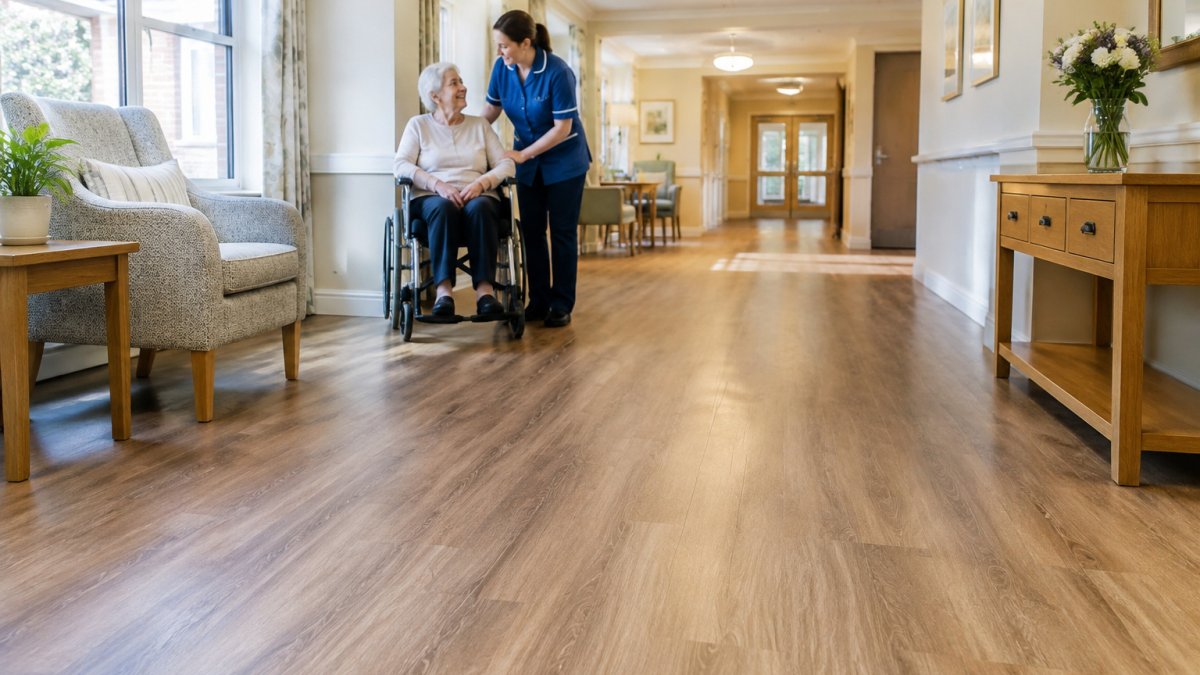
Noise is one of the most overlooked wellbeing factors in care homes, and care home flooring is one of the few things a home can change about it. Hard surfaces reflect sound, so footsteps, wheeled equipment and dropped items echo through corridors and into bedrooms. Choosing flooring that reduces noise in care homes is therefore a practical decision, not just an aesthetic one.
Research published on PubMed (2022) found that shock-absorbing flooring reduced fall-related injuries in care homes by 26.4% compared with rigid floors, and systematic review of shock-absorbing flooring for fall-related injury prevention. The same body of evidence notes a secondary benefit: better acoustic comfort for residents and staff.
How Acoustic Flooring Reduces Impact Noise and Echo
Acoustic flooring, a key type of care home flooring, works by absorbing the energy of impact rather than bouncing it back into the room. Flexible, cushioned surfaces compress under a footstep or a dropped tray, so less sound travels up through the floor and out across the space. Hard tiles do the opposite.
The practical difference shows up in two places: impact noise (footsteps, dropped items, trolley wheels) and reverberation (the lingering echo that makes a corridor feel loud even when nobody is shouting). Sound-absorbing flooring addresses both. Altro's guidance on acoustic flooring for impact noise describes this as a design aim in care environments.
Watch out: a floor that absorbs impact but has a thin, unbacked finish can still transmit noise between storeys, so check acoustic ratings rather than assuming any soft floor performs equally.
Acoustic Vinyl Flooring for Care Homes
Acoustic vinyl is often the most practical choice for care settings because it combines a cushioned or acoustic-backed layer with a wipeable surface. Manufacturers such as Tarkett's guidance on flooring for residents with dementia point out that softer, sound-absorbing flooring can reduce the anxiety that echoing hard surfaces create for residents with Alzheimer's disease.

For busy communal areas, prioritise an acoustic backing and a surface that tolerates frequent cleaning. Lighter, even tones also help residents read the floor safely.
Our team at Mobile Carpets and Flooring SW Ltd can bring samples to your home so you can compare tones and feel the underfoot difference before committing. Explore our Luxury Vinyl Tile range to see what is available.
Carpet, Rubber and Cushioned Options Compared
Flooring choices are easiest to compare when each option is judged on the same criteria. Impact noise is the sound transmitted when something lands on or rolls across the floor, and it is usually assessed as an impact sound reduction figure measured under standardised test conditions. Airborne sound absorption describes how much sound energy the surface itself soaks up within the room, which governs echo and reverberation. These are separate properties: a floor can perform well on one and poorly on the other, so a product sheet that quotes only one figure gives an incomplete picture.
When reviewing manufacturer data, check which test standard was used, whether the figure is for the flooring alone or for the flooring fitted over a specified subfloor and underlay, and whether the rating is given in decibels. Ratings measured on a concrete slab over a different structure will not transfer directly to a timber-framed upper storey, so compare like with like.
| Option | Impact noise (typical) | Echo control (typical) | Cleanability | Lifecycle considerations | Best for |
|---|---|---|---|---|---|
| Acoustic vinyl | Good with acoustic backing | Good | High | Long service life, low maintenance, repairable by replacing tiles | Corridors, communal areas |
| Carpet | Very good | Very good | Lower, needs deep cleaning and hygiene regimes | Shorter replacement cycle in high-traffic zones | Bedrooms, quiet lounges |
| Rubber | Good | Moderate | High | Durable under wheeled traffic, can be costly to supply and fit | Equipment-heavy zones |
| Cushioned vinyl | Good | Moderate | High | Moderate service life, simple to repair locally | Spaces adjacent to wet areas |
Carpet gives the strongest sound absorption and suits bedrooms and quiet lounges, but its acoustic performance can decline as the pile flattens and it accumulates soil. Rubber handles heavy wheeled traffic well and resists indentation, though its echo control is more moderate. Cushioned vinyl offers a middle path, with easier cleaning than carpet and a softer footfall than standard vinyl.
Watch out: a 'very good' acoustic rating for carpet assumes a suitable underlay; without one, the advantage over hard vinyl narrows considerably.
Hygiene and Cleanability Trade-offs
Soft surfaces absorb sound best, but they must be balanced against infection control. Carpet traps spills and allergens and is harder to decontaminate in clinical areas, while smooth vinyl and rubber clean quickly with routine disinfectants. A common approach is carpet in resident bedrooms and lounges, with acoustic vinyl or rubber in corridors, kitchens and treatment rooms, so that the noise benefit is kept where people rest and the hygiene burden is concentrated where it can be managed.
Dementia-Friendly Flooring Design
Dementia-friendly design focuses on reducing visual confusion and sensory overload. Uniform, low-pattern floors avoid the false impressions that busy patterns can create, and softer acoustics reduce the startling echoes that can distress residents. Flooring should also contrast subtly with walls and skirting so edges are easy to see.
Slip resistance and a stable, even surface matter just as much, since perceived hazards can make residents hesitant to walk.
CQC Care Home Environment Standards
In England, the Care Quality Commission (CQC) inspects care homes against fundamental standards covering safe, effective and well-led care, which include a safe and suitable environment. Flooring that is damaged, slippery or hard to clean can be raised as an environmental concern. Check the current CQC guidance on regulated activities for the latest wording, as expectations are updated over time.
Specifying Quieter Flooring for Your Care Home
A practical specification weighs acoustics against the other requirements a care home must meet. Start with a room-by-room assessment: note where impact noise is worst, which areas residents use most, and which spaces need the most frequent cleaning or decontamination. Then score each candidate floor against a short set of criteria, such as impact noise performance, slip resistance, cleanability, infection control suitability, durability under wheeled traffic, and whole-life cost.
A simple decision matrix helps. Assign each criterion a weight that reflects the room type, so that slip resistance and cleanability carry more weight in treatment rooms and kitchens, while acoustic performance carries more weight in bedrooms and lounges. Request acoustic ratings, slip resistance data and maintenance instructions for each shortlisted product, and compare them on the same test basis.
Lifecycle cost is often underestimated. Compare expected service life, cleaning regimes and chemicals, the ease of replacing individual tiles or sections, and the downtime each repair would cause. A floor that is cheaper to fit but needs deep cleaning or early replacement can cost more over ten years than a higher-specification alternative.
Where the building is occupied, plan the works in phases. Agree access routes and times with the home, keep residents' rooms and key routes available, and consider temporary relocation for residents who are most disturbed by noise or who need a quieter room during the works. Installation noise itself should be scheduled and managed, since the process of fitting a quieter floor can be disruptive.
Our team can supply and fit flooring packages, and we are happy to talk through options during a home visit. You can book a consultation to discuss your building, or browse our commercial flooring range for communal and institutional spaces.
Frequently Asked Questions
What is the best flooring for reducing noise in a care home?
Acoustic-backed vinyl and cushioned flooring are the most practical choices for most care home areas, because they absorb impact noise from footsteps, dropped items and wheeled equipment while still being easy to clean. Carpet absorbs sound most effectively, but it needs careful consideration in clinical and high-spillage areas. The right choice depends on the room, the traffic it carries and your infection control protocol. A flooring specialist can help compare acoustic ratings for each area before you commit.
Does shock-absorbing flooring actually reduce injuries in care homes?
Shock-absorbing flooring can be a useful part of a wider fall-prevention strategy, alongside staffing, mobility assessment and room layout.
What are the CQC requirements for flooring in care homes?
The Care Quality Commission does not prescribe specific flooring products, but its standards expect care home environments to be safe, clean and suitable for the people living in them. Flooring should support infection control, be slip-resistant and be maintained to a good standard. Providers should be able to show how their choices meet these expectations and reflect the needs of residents, including those with dementia.