 Listicle
Best LVT Flooring for Families: 2026 Buying Guide
Table of Contents
- What Makes LVT Flooring the Best Choice for Family Homes?
- LVT Flooring Durability Ratings: What the Numbers Mean
- Quick Comparison: Top LVT Brands for Busy Households
- Karndean vs Amtico for Families: Which Premium Brand Wins?
- How to Clean LVT Flooring: A Simple Maintenance Schedule
- Family-Specific Features to Prioritise: Noise, Safety, and Repairs
- Which LVT Flooring Should Your Family Choose?
- Frequently Asked Questions
Last Updated: September 8, 2026
Choosing the best LVT flooring for families comes down to one question: can it survive the daily chaos of spills, muddy shoes, and energetic play while still looking good years later? Luxury vinyl tile (LVT) has become the go-to resilient flooring for busy households because it combines the look of natural wood or stone with the practical toughness that family life demands.
What Makes LVT Flooring the Best Choice for Family Homes?
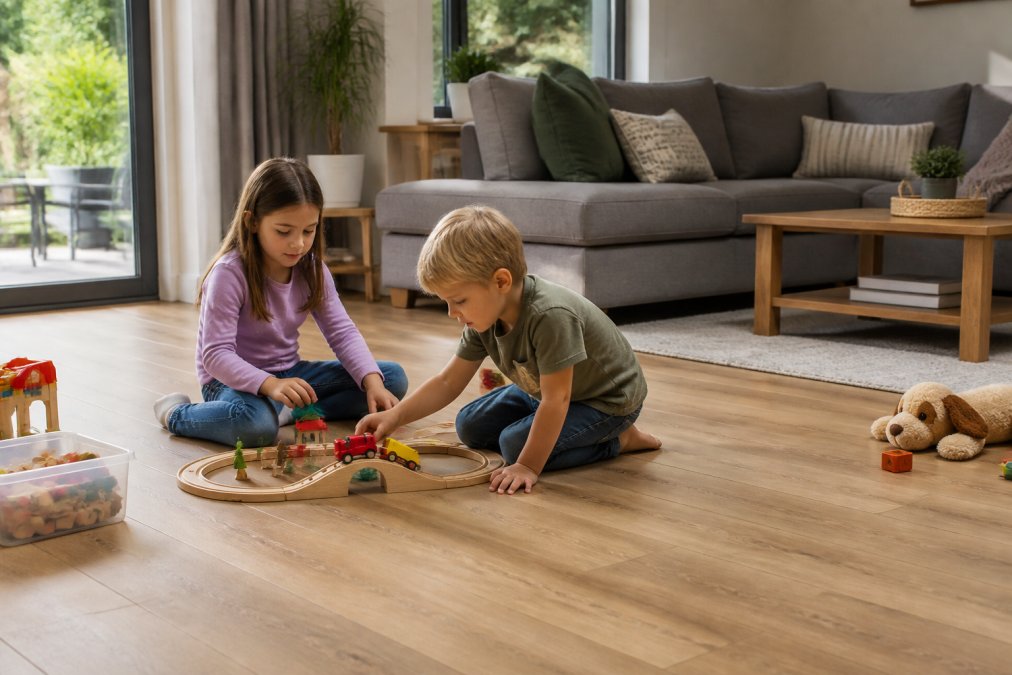
LVT flooring is a multi-layer resilient flooring product that replicates wood, stone, or tile aesthetics through a photographic print layer protected by a clear wear layer. Unlike laminate or real hardwood, LVT is completely waterproof, making it a practical choice for kitchens, bathrooms, and open-plan living areas where spills are inevitable.
Embossed-in-register technology aligns the printed grain with the physical texture, so a wood-effect plank feels like real timber underfoot and offers better slip resistance than smooth, glossy alternatives. When weighing up the best lvt flooring for families, the combination of waterproof construction, realistic aesthetics, and forgiving underfoot comfort sets it apart from older vinyl options.
LVT Flooring Durability Ratings: What the Numbers Mean
The single most important specification to check is the wear layer, the clear protective coating that shields the printed design from scratches and scuffs. Measured in mils (one mil equals 0.0254 mm), this number directly determines how the floor will hold up in high-traffic areas. A 12 mil wear layer suits light residential use, but for busy family households with children and pets, a 20 mil or 30 mil layer provides significantly better scratch resistance and longevity.
Impact resistance is another factor that separates family-grade LVT from budget options. Rigid core planks, often called WPC or SPC, are engineered to withstand dropped toys and heavy furniture without denting. Many premium collections carry a residential warranty covering structural integrity for 20 years or more.
Quick Comparison: Top LVT Brands for Busy Households
Several manufacturers have earned strong reputations for family-friendly LVT, each with distinct strengths. COREtec Originals Premium features a signature cork backing for excellent acoustic insulation in multi-story homes. Mannington Adura Max uses an 8mm thick WPC core that is exceptionally forgiving on uneven subfloors. Shaw Floors Floorté Pro is engineered with enhanced scratch and stain resistance, ideal for households with pets. Mohawk SolidTech offers superior dimensional stability, resisting expansion in sun-drenched open-plan spaces.
| Brand | Wear Layer | Core Type | Standout Feature | Best For |
|---|---|---|---|---|
| COREtec Originals | 30 mil | WPC with cork back | Acoustic dampening | Noise reduction |
| Mannington Adura Max | 20 mil | WPC, 8mm thick | Subfloor forgiveness | Older properties |
| Shaw Floors Floorté Pro | 20 mil | Waterproof core | Scratch resistance | Pets and children |
| Mohawk SolidTech | 20 mil | Rigid core | Dimensional stability | Sunlit open-plan areas |
Each of these brands delivers commercial-grade resilience in a residential package. The right choice depends on your home's specific pressure points, whether that is a noisy upstairs hallway, an uneven ground-floor slab, or a kitchen that sees constant foot traffic.
Karndean vs Amtico for Families: Which Premium Brand Wins?
Karndean and Amtico dominate the premium end of the UK market. Karndean is renowned for its incredibly realistic wood and stone designs. Amtico is often praised for its sponge-backed underlayment options that add comfort and acoustic insulation, as well as its extensive commercial-grade warranty coverage.
For family use, the decision often comes down to installation method and repairability. Both brands offer glue-down installation, which creates a permanent, stable bond ideal for large open areas, and both are available in click-lock system formats for floating installations. Glue-down floors are harder to replace plank by plank, while click-lock systems allow for individual tile replacement if a section gets damaged. The Karndean vs Amtico choice ultimately hinges on whether you prioritise design realism or underfoot comfort.
How to Clean LVT Flooring: A Simple Maintenance Schedule
A straightforward maintenance routine keeps LVT looking new for decades. But a family home is not a showroom. Here is how to handle the real-world messes that a standard cleaning guide ignores.
The Daily and Weekly Routine
- Daily: Sweep or vacuum with a soft brush attachment to remove grit and sand, which are the primary causes of surface scratches. Pay special attention to entryways and under dining tables where crumbs and dirt accumulate.
- Weekly: Damp mop with a microfiber mop using a manufacturer-approved cleaning solution. The key is to use a well-wrung mop; standing water can seep into the seams of a click-lock floor over time, even if the planks themselves are waterproof.
- Monthly: Spot-clean stubborn marks with a diluted solution and a soft cloth.
- Annually: Check for any damage to the wear layer and address chips or scratches promptly.
Handling the Messes That Matter
Pet accidents: The waterproof nature of LVT means urine will not cause warping, but it can leave a lingering odour if not cleaned properly. Blot up the mess immediately, then clean the area with an enzymatic cleaner specifically designed for pet waste. Avoid bleach or ammonia-based products, which can discolour the floor and damage the wear layer.
Art supplies and markers: For crayon, felt-tip pen, or playdough, do not scrub aggressively. First, try a dry erase marker over the mark, then wipe it away with a soft cloth. If that fails, use a small amount of isopropyl alcohol on a cotton bud.
Chewing gum or sticky residue: Harden the gum with an ice cube in a plastic bag, then scrape it off gently with a plastic scraper. Never use a metal blade, which will scratch the wear layer. For sticky residue from stickers or tape, a dab of WD-40 or a citrus-based cleaner will lift it without harming the floor.
The Textured Finish Trap
Wood-effect and stone-effect LVT often have a textured surface to mimic the natural material. This texture is great for slip resistance, but it can trap dirt in the embossed grooves. A standard flat mop will simply push dirt into these low spots. For textured floors, use a mop with a scrubbing strip or a soft-bristled brush attachment on your vacuum. A weekly pass with a slightly damp microfiber cloth wrapped around a flat mop, moving in the direction of the grain, will lift dirt out of the texture more effectively than a random circular motion.
What to Avoid: The Silent Killers
- Steam mops: The high heat and moisture can weaken the adhesive in glue-down floors and cause the locking mechanism in click-lock floors to expand and fail over time. The heat can also dull the finish of the wear layer.
- Harsh abrasives: Scouring pads and abrasive cleaning powders will micro-scratch the wear layer, making it look dull and hazy over time.
- Oil-based cleaners: These can leave a greasy film that attracts more dirt and makes the floor slippery.
- Bleach and ammonia: These can discolour the print layer and degrade the protective coating.
By adapting your cleaning routine to the specific challenges of your household, you will protect your investment and keep the floor looking its best for the full length of its warranty.
Family-Specific Features to Prioritise: Noise, Safety, and Repairs
Most guides focus on brand names, but the features that truly matter for family life are noise reduction, safety, and repairability.
Acoustic Performance: Keeping the Peace in Multi-Storey Homes
In a house with children, the sound of footsteps and dropped toys travelling through floors is a constant annoyance. The key metric is impact sound transmission, measured in decibels (dB). The lower the number, the better the floor absorbs noise. A bare LVT plank on a concrete slab might register around 70 dB or more; adding a quality underlayment can reduce this to the mid-50s dB range.
When choosing a product, look for an integrated acoustic backing. A cork backing is a natural sound absorber and adds slight cushioning underfoot. A foam backing (often IXPE or similar) is lighter and cheaper but offers less mass for sound dampening. If your chosen plank has no backing, budget for a separate underlayment. Always check the product's technical data sheet for its acoustic rating (often expressed as ΔLw, the improvement in impact sound). A ΔLw of 20 dB or more is a strong indicator of good performance.
Slip Resistance: A Deeper Look at Safety
Slip resistance is not just about the finish; it is about the interaction between the surface and water or dirt. The standard measure in the UK is the pendulum test value (PTV). A PTV of 36 or above is generally considered safe for domestic settings (hse.gov.uk). Textured finishes naturally provide more grip than a smooth, high-gloss surface, but be wary of deep textures that can trap dirt. A micro-beaded or lightly embossed texture often offers the best balance of slip resistance and easy maintenance.
Repairability: The Practical Guide to Replacing a Single Plank
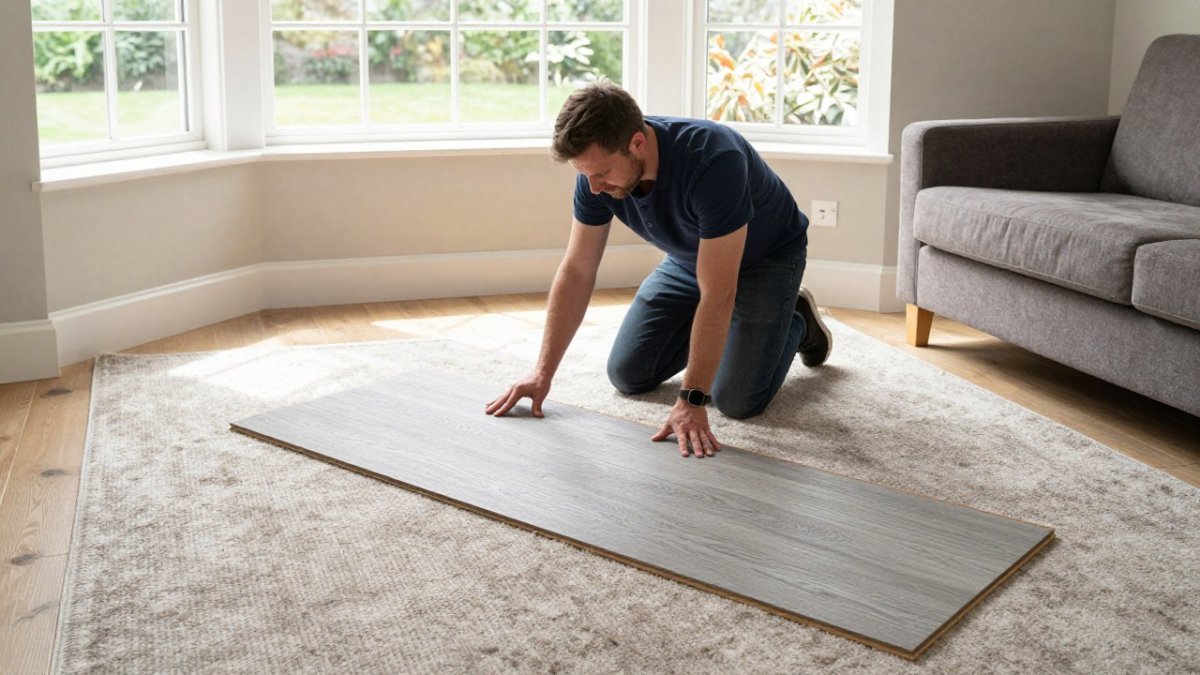
The ability to replace a single damaged tile is a massive advantage for families. A dropped pan or a dragged toy can scratch a plank beyond repair. With a click-lock system, this is a manageable DIY task:
- Isolate the plank: Use a circular saw or multi-tool to cut a line down the centre of the damaged plank, being careful not to cut into the subfloor.
- Pry it out: Use a chisel and hammer to break the plank into pieces, working from the centre cut towards the edges. This releases the locking mechanism without damaging the surrounding planks.
- Prepare the new plank: Cut the tongues off the new plank's long and short sides that will connect to the adjacent planks.
- Glue it down: Apply a strong flooring adhesive to the subfloor and the cut edges of the new plank. Press it into place. Use weights to hold it down while the adhesive cures.
This method works because the new plank is essentially floated in place. It will not be as securely locked as the original, but for a small area in a home, it is a durable and invisible repair. This is why it is essential to buy 10-15% extra material at the outset; matching a dye lot years later is nearly impossible.
Non-Toxic and Low-Emission Flooring: A Healthier Home
Families are increasingly aware of indoor air quality. LVT is a synthetic product, so it is worth checking its emissions. Look for certifications that guarantee low levels of volatile organic compounds (VOCs). In Europe, the CE mark is mandatory, but a stronger voluntary standard is the Blue Angel (Der Blaue Engel) eco-label (europa.eu). Also, ask for products that are explicitly phthalate-free. Phthalates are plasticisers sometimes used to make vinyl flexible, and they have been linked to health concerns. Many premium brands now offer phthalate-free ranges.
Which LVT Flooring Should Your Family Choose?
The best LVT flooring for families balances durability, comfort, and practical maintenance against your budget. For most busy households, a mid-range rigid core plank with a 20 mil wear layer and a click-lock system offers the ideal combination of scratch resistance, waterproof performance, and easy repairability. If noise reduction is your priority, invest in a product with an integrated acoustic backing like cork. If your home has uneven subfloors, a thicker WPC plank will save you headaches during installation.
Getting the specification right is only half the challenge; professional installation matters just as much as the product itself. Poor subfloor preparation and incorrect fitting are the most common causes of premature floor failure. This is where the convenience of a mobile showroom pays off. Mobile Carpets and Flooring SW Ltd brings thousands of samples directly to your door, allowing you to test textures and colours in your own lighting.
Choosing the best LVT flooring for families requires balancing wear layer thickness, core type, and acoustic features against the specific demands of your household. The right floor should withstand daily wear, resist moisture, and keep noise levels down, all while complementing your interior design. Mobile Carpets and Flooring SW Ltd offers a stress-free, at-home selection process with expert guidance tailored to your style and budget, backed by professional installation from a family-run business with over 25 years of experience.
Frequently Asked Questions
What is the best brand of LVT flooring for high-traffic areas?
For high-traffic family areas, look for a wear layer of at least 20 mil and a rigid core construction. Brands like COREtec Originals Premium and Shaw Floors Floorté Pro are designed for busy households. COREtec features a 30 mil wear layer and cork backing for sound absorption, while Shaw's Floorté Pro offers enhanced scratch resistance for pets and children. Always check the durability rating and warranty before purchasing.
Is Karndean or Amtico better for families?
Both Karndean and Amtico are premium LVT brands, but they suit different needs. Karndean offers a wider range of realistic wood and stone effects with a strong warranty, making it excellent for design-focused families. Amtico is renowned for its durability and softer feel underfoot, which helps in playrooms. For families, consider Amtico if comfort and impact resistance are priorities, or Karndean if you want a specific aesthetic with proven longevity.
What are the negatives of LVT flooring?
LVT flooring has a few drawbacks. It can be more expensive than laminate or standard vinyl. While waterproof, it can be damaged by extreme heat, so protect it from hot pans. Some types require a perfectly smooth subfloor to prevent imperfections showing through. Also, cheaper LVT with thin wear layers can scratch or indent under heavy furniture, so investing in a higher durability rating is essential for family homes.
Is LVT flooring waterproof and suitable for family kitchens?
Yes, most modern LVT flooring is 100% waterproof, making it ideal for family kitchens. Unlike laminate, which can swell when wet, LVT handles spills and splashes without damage. Look for products with a waterproof core, such as Mannington Adura Max or Mohawk SolidTech, which offer excellent dimensional stability. This makes it a practical choice for open-plan areas where the kitchen meets the living space.
How do I maintain LVT flooring with children and pets?
Maintaining LVT flooring with children and pets is straightforward. Sweep or vacuum regularly to remove grit that can scratch the surface. For mopping, use a damp mop with a pH-neutral cleaner specifically designed for LVT, avoiding harsh chemicals. Wipe up spills immediately to prevent staining. Place mats at entrances to reduce dirt, and use felt pads under furniture legs to prevent indentations.